

Inside the Clinical Implant Program: What Ten Days Actually Covers
ConfiDental Education Center
Programme team
Implantology is usually taught as a surgical skill. That framing is the reason a lot of courses leave people able to place an implant and unable to restore one.
The Clinical Implant Program is built around four areas rather than one — implant radiology, surgery, prosthetics, and periodontal concepts. Ten days, six hands-on workshops, and up to ten clinical cases. Here's what sits in each block, and why they run in that order.
1. Radiology and planning come first
The programme opens with CBCT — an introduction to implant radiology, then interpretation and treatment planning, then the planning software workflow itself. Applied anatomy and prosthetically driven implantology sit in this block too.
Putting radiology first is a deliberate choice. Prosthetically driven implantology means the final restoration determines where the implant goes, not the other way round. That decision is made at the planning stage, on the scan — long before anyone picks up a handpiece.
The position of an implant is a prosthetic decision made with a surgical instrument.
2. The science before the surgery
Osseointegration and implant design, then implant components and case selection. This is the block that explains why one implant is not interchangeable with another, and why case selection is where most avoidable failures are decided.
3. Surgery
Surgical protocols and guided surgery concepts, the immediate implant workflow, complication management, and flap design and suturing technique.
Complication management is taught alongside the protocols rather than as an afterthought at the end. Knowing what to do when a case deviates is part of knowing how to start it.
4. Tissue management and regeneration
Hard and soft tissue management, bone grafts, membranes and growth factors, and guided bone regeneration and ridge augmentation.
This is the perio component, and it is what separates a programme that can handle real cases from one that only works on ideal ridges. In practice, the sites that need implants are frequently the sites that have already lost bone.
5. Prosthetics — the largest block
Nine topics: prosthetic considerations and loading protocols, 3D prosthetic positioning, healing abutments and customised healing concepts, impression techniques, verification jigs and implant connections, abutment solutions and materials, screw-retained versus cement-retained restorations, implant protected occlusion, and digital technology in implant prosthetics.
It is the largest block on purpose. Once the implant has integrated, everything that determines whether the patient is happy in five years is prosthetic — the emergence profile, the occlusion, the retrievability of the restoration when something needs attention.
The workshops
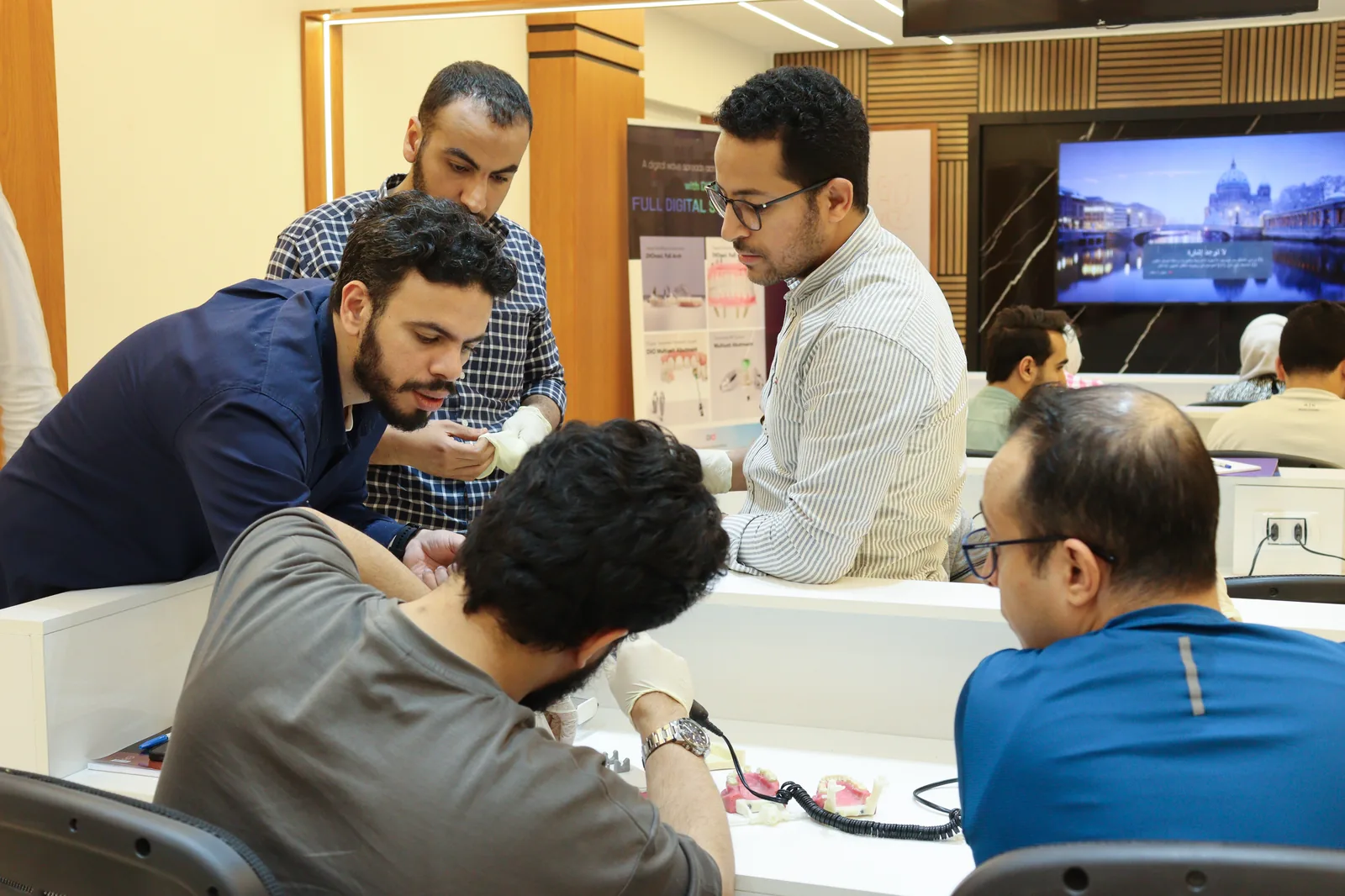
Six of the ten days include hands-on work: implant drilling and impression techniques, and ridge augmentation and suturing workshops. These are not demonstrations. Participants work at their own station, with instructors circulating to correct technique in the moment.
Alongside that, the programme includes up to ten clinical cases — the step where the workshop technique meets an actual patient, under supervision.
The programme at a glance
- 10 teaching days across four clinical areas
- 6 hands-on workshops
- Up to 10 supervised clinical cases
- 5 instructors, each covering their own area
- Running in Cairo, Alexandria, Damietta, Ismailia and Asyut
Who it suits
Practitioners placing their first implant, and practitioners who have been placing them for years without ever formalising the prosthetic side. The sequence works for both, because it starts from planning rather than assuming it.
See the full syllabus and register your interest, or download the programme PDF.