

Guided Bone Regeneration: When Ridge Augmentation Is Worth It
ConfiDental Education Center
Programme team
Not every deficient ridge needs grafting. Knowing which ones do — and which ones to refer — is most of the skill.
Guided bone regeneration is one of the most useful techniques in implant dentistry and one of the most over-applied. This is a framework for deciding when augmentation is genuinely indicated, what it realistically achieves, and where predictability drops off.
The principle in one paragraph
GBR works by creating and protecting a space next to bone, then keeping faster-growing soft tissue out of that space long enough for bone to fill it. A barrier membrane does the excluding, a graft material holds the space open, and the biology does the rest.
Everything that makes a GBR case succeed or fail comes back to one of four things: the space, the barrier, the blood supply, or the closure.
Space maintenance, cell exclusion, blood supply, and a wound that stays shut. Everything else is detail.
When augmentation is worth it
The honest answer: when the alternative compromises the restoration you have already planned.
If you planned the crown position first, the question answers itself. Either there is enough bone to place an implant where the restoration requires, or there is not. If there is not, you augment, change the restorative plan, or refer.
Reasonable indications
- Dehiscence or fenestration around an otherwise well-positioned implant.
- Horizontal deficiency where the ridge is too narrow for the planned diameter.
- Socket preservation where the site will be restored later and collapse would compromise it.
- Localised defects with intact surrounding walls — the more walls, the more predictable.
Where predictability drops
Not all defects are equally forgiving. Broadly, the more surrounding bony walls a defect has, the more predictable the outcome — a well-contained defect largely regenerates itself if you protect it.
Vertical augmentation is a different proposition to horizontal. It is technique-sensitive, carries a higher complication rate, and demands tension-free primary closure that many practitioners underestimate. It is not something to attempt on the strength of a weekend course.
| Situation | Predictability | Why |
|---|---|---|
| Contained defect, multiple walls | High | Anatomy already maintains the space |
| Dehiscence around a stable implant | High | The implant provides the scaffold |
| Horizontal ridge augmentation | Moderate | Depends heavily on flap management |
| Vertical ridge augmentation | Lower | Technique-sensitive, higher complication rate |
The thing that actually fails is the soft tissue
Most GBR failures are not graft failures. They are wound failures.
If the flap is under tension it opens. If it opens the membrane is exposed. If the membrane is exposed the graft is contaminated and the result is compromised, often entirely.
That is why flap design and suturing are taught as core implant skills rather than as an afterthought. Periosteal releasing incisions, passive closure and suture technique determine the fate of the graft you just spent an appointment placing.
Before you close, check
- The flap reaches passively — it should sit closed with nothing holding it there.
- The membrane is fully covered and stable.
- No sharp graft particle is tenting the flap from underneath.
- The suture line avoids sitting directly over the graft where anatomy allows.
Materials matter less than the marketing suggests
Autogenous bone remains the biological reference standard, but harvesting carries morbidity and volume limits. Xenografts and allografts are widely used, well documented, and behave predictably as space maintainers.
Resorbable membranes are simpler and avoid a second surgery. Non-resorbable membranes maintain space better in demanding cases but are less forgiving when exposed.
The material choice matters less than whether you maintained space, excluded soft tissue and closed without tension. Practitioners tend to spend a lot of energy on the first decision and not enough on the last three.
When to refer
There is no shame in referring, and the cases worth referring early are easy enough to identify: large vertical defects, compromised soft tissue, medically complex patients, and anything in the aesthetic zone where you are not confident of the soft tissue result.
Referring a case you cannot predictably manage is a better clinical decision than attempting it — and a considerably better commercial one than managing the complication.
Learning it hands-on
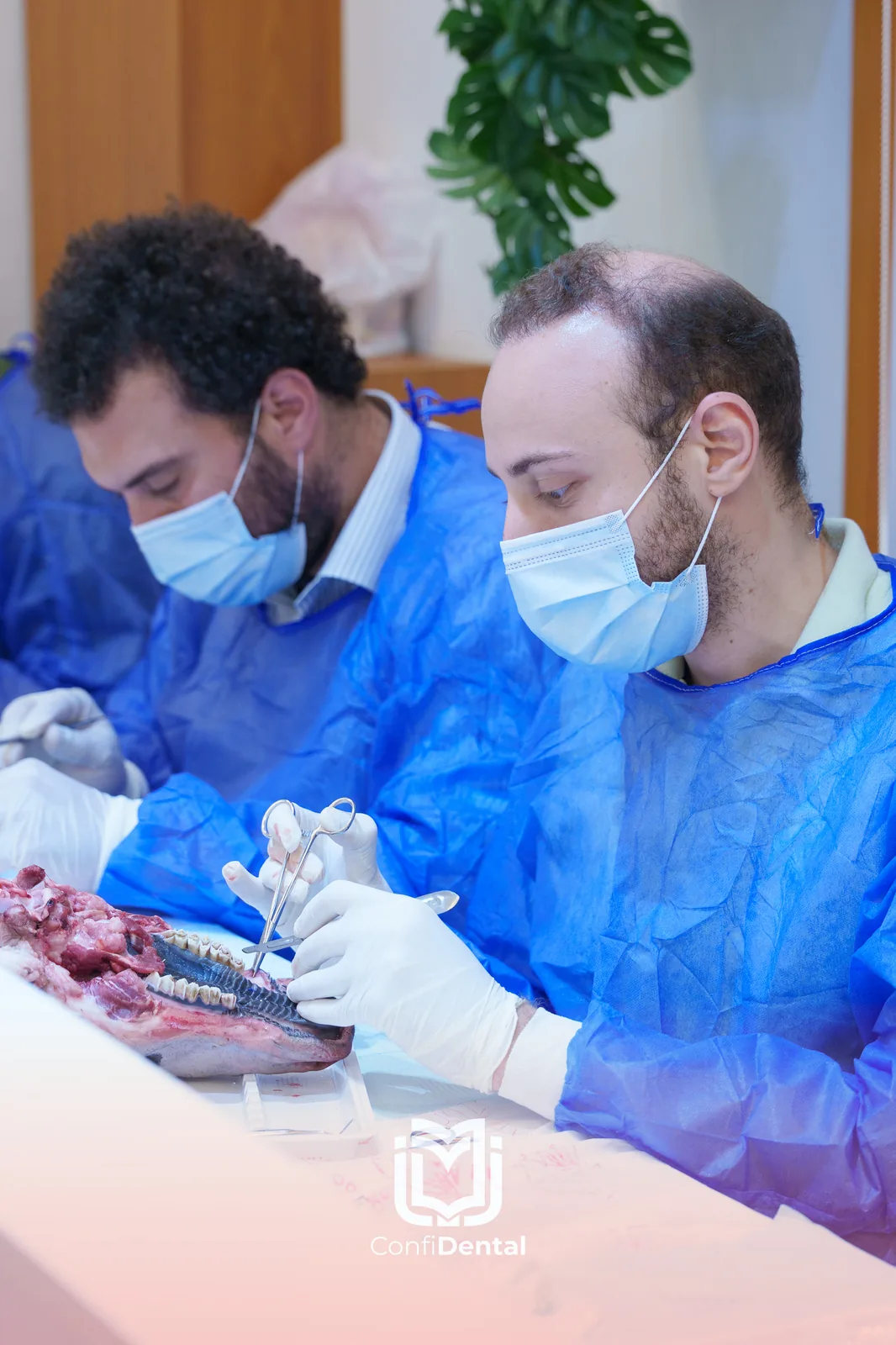
Ridge augmentation and suturing are two of the six workshops in the Clinical Implant Program, alongside the bone graft, membrane and growth factor content in the syllabus. Flap design and suturing are practised at the bench before they meet a patient.